quark
Quantized Array Reprojection with Kahan Summation
QUARK is a reprojection and aggregation engine for xarray datasets with 2-D geolocation arrays. It is designed to be simple for common workflows and extensible for advanced use cases.
Map Example
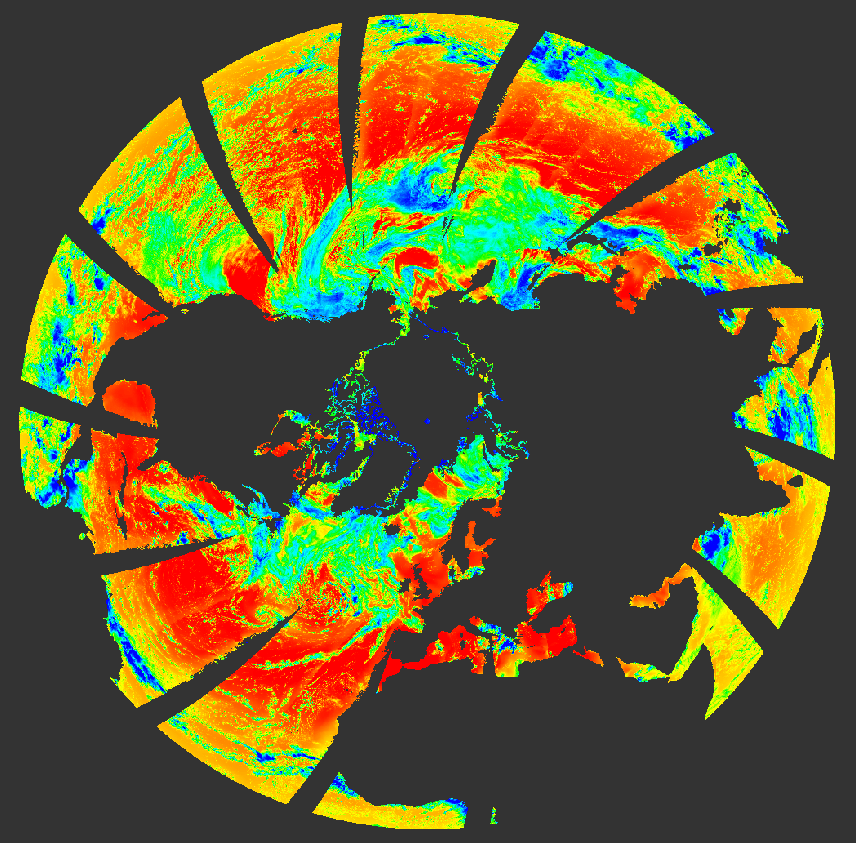
Figure 1 — SEN3 OLCI: Daily PAR (Photosynthetically Active Radiation) aggregated and reprojected to a polar view using QUARK.
Highlights
- N-dimensional datasets — 2D, 3D, 4D, and beyond
- Multi-dataset processing — accumulate across multiple datasets in one pass
- Supersampling — improved spatial coverage with subpixel grids
- Multiple projections — equirectangular, polar, and extensible
- Kahan Summation — improved numerical accuracy (requires numba)
Installation
Install quark from the HYGEOS package index:
hyp add --hygeos quarkOr install directly from source:
pip install -e ".[git]"Quick Example
import xarray as xr

from quark.aggregate import Aggregator
from quark.projection.equirectangular import EquiRectangular
from quark.utils import bbox_area

ds = xr.open_dataset("input.nc")

projection = EquiRectangular(
    width=2000,
    height=2000,
    area=bbox_area(ds, margin=0.05),
)

result = Aggregator(
    projection=projection,
    datasets=[ds],
    return_counts=True,
).compute()

result.to_netcdf("output.nc")
Features Overview
Supersampling
Supersampling projects a factor x factor subpixel grid for each source pixel, improving coverage when the source footprint is large relative to the target grid.
Two modes are available:
SpatialSuperSampler— estimates local pixel width from neighboring pixels. Works well for structured rasters and well-behaved swaths.ConstantSuperSampler— uses a fixed width (e.g.,"1km"). Safer for irregular geolocation data.
Spatial supersampling assumes that array neighbors are also spatial neighbors. Do not use it for unstructured inputs, badly ordered swaths, or 2-D arrays whose neighborhood topology is not physically meaningful.
Projections
Projection support is class-based. Built-in projections include:
Additional projection classes can be added as long as they expose the methods expected by Aggregator.
Kahan Summation
For high-precision accumulation, use sum_method="kahan":
result = Aggregator(
    projection=projection,
    datasets=[ds],
    sum_method="kahan",
    return_counts=True,
).compute()Kahan Summation requires numba and is slower than naive summation, but provides significantly better numerical accuracy for large accumulations.
Input Model
QUARK expects:
- a 2-D
latitudevariable - a 2-D
longitudevariable - matching shapes and dimensions for both
- data variables that include those spatial dimensions
This makes it a strong fit for swaths and geolocated rasters, but not for generic point clouds or arbitrary meshes.
Next Steps
- Getting Started — step-by-step guide
- API Reference — detailed documentation for all classes and functions